Wednesday, March 28, 2018

Waze launches ‘Local’ ads primarily aimed at SMBs and franchises

Previewed roughly a year ago, Waze is now introducing “Waze Local,” map-based ads aimed primarily (though not exclusively) at small businesses. Designed to be simple to buy and set up, it features three ad units:

  • Branded Pin.
  • Promoted Search.
  • Zero-Speed Takeover.

Below are screen mockups of each type of ad.

The Branded Pin offers additional information when it’s clicked. Promoted Search gives priority rankings to advertisers in a search context (like AdWords), and the Zero-Speed Takeover is a banner that only appears during traffic stops.

In an internal study with 1,400 US advertisers during the beta period, Waze said advertisers saw “20.4 percent more monthly navigations when they started advertising with Waze Local.”

Beyond the ads themselves, there are two primary offerings that feature different pricing for different segments: “Starter” and “Plus.” Starter is for businesses with fewer than 10 locations. Plus is for businesses with up to 50 locations (e.g., franchises and regional chains). There’s also an enterprise offering for companies with more than 50 locations.

With “Starter,” businesses can pay $2 per day (or more). With Plus, it’s roughly $100 per day at a minimum. Plus also offers live support, whereas Starter does not. Advertisers can set budget caps, as with AdWords.

Matt Phillips, who’s in charge of the global SMB team at Waze, told me that setup takes under five minutes and that the units and dashboard were designed with considerable input from SMBs. Accordingly, Waze will report:

  • Impressions.
  • Clicks.
  • Navigations.
  • Call and URL information.
  • Info Button clicks.

Plus users get additional metrics and reporting.

Currently, this is not tied into any other Google advertising product. It’s sold directly, although a small number of resellers are operating in the market and there may be more in the future, according to Phillips.

He concluded by telling me that Waze has over 100 million active users and that on average, users spend 11 hours per month in the app. That gives it engagement parity with Instagram and more than Snapchat, according to the data I was shown.

The post Waze launches ‘Local’ ads primarily aimed at SMBs and franchises appeared first on Search Engine Land.

Google honors Hannah Glasse, first popular cookbook writer, with a Google doodle

Hannah Glasse, the English cookbook writer of the 18th century, is being honored today on the Google home page with her own Google doodle. The doodle shows a woman loading food into an old-fashioned oven with a book below.

Hannah Glasse was a pioneer who wrote the most popular cookbooks in her times. “The Art of Cookery Made Plain and Easy,” her cookbook, was published in 1747 and was printed in 40 editions, many of which were pirated. The book was written in plain English so it could be used by all types of people, no matter their education level.

Hannah Glasse was born in London 310 years ago on March 28, 1708, and passed away at the age of 62 on September 1, 1770. She had a large family. Some say she had 10 children, some say she had 11.

Google wrote:

If the thought of Yorkshire pudding and gooseberry fool makes your mouth water, you have Hannah Glasse to thank for making these two delectable dishes staples in English cuisine. Born on this day in 1708, Glasse was a pioneering English cook and author of the most popular cookbook of the 18th century. Published in 1747, The Art of Cookery Made Plain and Easy was unique; it was one of the first cookbooks written in a simple and conversational style, which meant that any English speaker and reader — regardless of their class — could learn how to cook.

Glasse’s cookbook was popular not only because it was easy to read, but also because of its massive scope. It included a whopping 972 recipes, covering everything from puddings and soups, to what to serve at Lent, to preparing food for the sick.

Today’s Doodle features Glasse whipping up a batch of classic Yorkshire puddings. Her recipe for Yorkshire pudding, among many others, is one of the earliest known ever published.

Happy 310th birthday, Hannah Glasse!

Illustration by Matthew Cruickshank

The post Google honors Hannah Glasse, first popular cookbook writer, with a Google doodle appeared first on Search Engine Land.

Bing Ads Editor getting support for account level ad extensions

Bing Ads rolled out account level ad extensions in September 2017, allowing advertisers to assign an extension across all the campaigns in an account. Now, there is finally starting to be support for them in Bing Ads Editor.

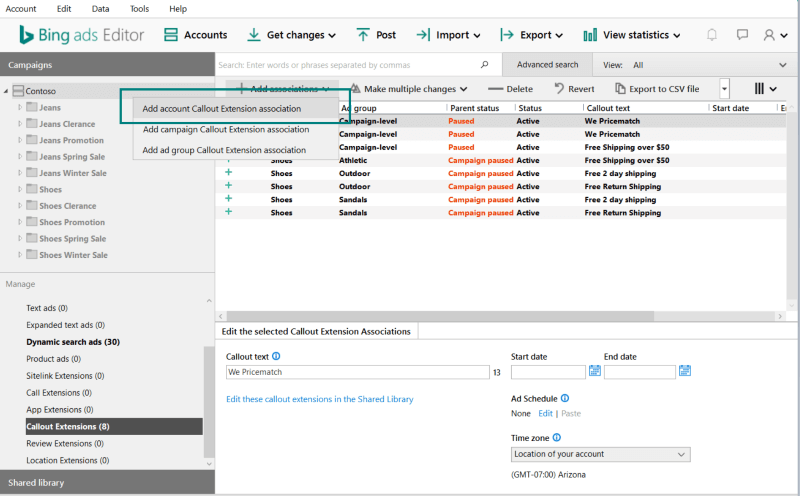
Starting with callout extensions, advertisers will be able to associate account-level ad extensions in Editor as shown in the screen shot below.

Bing Ads Editor will support account-level ad extensions.

You’ll need to select the account level in the navigation in the upper right to access account-level extensions. And, as with shared library updates, account level ad extension associations are always posted, regardless of whether all campaigns or selected campaigns are being posted.

Support for other extensions at the account level will be rolling out in the near future.

The post Bing Ads Editor getting support for account level ad extensions appeared first on Search Engine Land.

Delivering optimized media-rich content for mobile

We all know the adage, “A picture is worth a thousand words,” meaning that a complex idea can be conveyed in just one image. The phrase was made popular nearly 100 years ago in an article about the power of images in advertisements, and the sentiment rings just as true in today’s always-on digital age. It’s been said that the human brain processes visual information 60,000 times faster than text, and research supports that images directly impact mood and invoke a variety of emotions.

This makes visual media, both images and video, a powerful tool full of marketing potential. According to YouAppi’s CMO Mobile Marketing Guide, 85 percent of digital marketers plan to boost their mobile marketing budget for videos in 2018 by 10 percent over 2017 levels. That’s to meet a marked surge of interest in videos, which are a superb medium for personalization and connections.

Source: YouAppi’s 2018 CMO Mobile Marketing Guide

During an interview in 2017, Pinterest CEO Ben Silberman said, “A lot of the future of search is going to be about pictures instead of keywords.” We aren’t quite there yet, but the visual web has changed the game. All signs point to continued growth in the use of media-rich content to engage digital consumers.

Mobile is king

Mobile reigns supreme in today’s digital world. More than half of the time we spend each day with digital media is done with our mobile devices, and 80 percent of all shoppers make purchases via smartphones, logging billions of transactions and revenue every month.

By 2019, mobile advertising is forecasted to represent 72 percent of all US online ads. Notably, smartphone owners often search while on mobile devices and are five times more likely to leave a mobile-unfriendly site. If you aren’t providing the best mobile experience possible, you are likely losing out to your competitors that are.

If media-rich content provides a powerful vector of communication with your target consumers, and you need to reach them on their platform of choice — their mobile device — the path forward is clear. You need to provide a media-rich, engaging experience, delivered seamlessly to their mobile device. Great! Let’s all do that…

Easier said than done

Unfortunately, this can be more challenging than many think. Over the past three years, as a result of the ubiquity and large file size of non-text content, the average weight of a webpage has increased by nearly 85 percent, leading to slower load times. Research has shown that even a three-second loading time causes a 53 percent bounce rate.

Factor in the shift to Mobile-First Indexing by Google, and that page load speed will be a ranking factor for mobile searches, optimizing your mobile web content is critical to your SEO and user experience. Then, layer on top of that the thousands of different mobile devices, various network providers, browser types and screen sizes, and creating a robust experience for customers requires dedicated collaboration, cooperation and coordination among knowledgeable marketing and development professionals.

Overcoming the challenges

Here are the three top challenges marketers will need to overcome to create an optimized media-rich experience for mobile devices and thereby improve user engagement.

  1. File size: Videos and images take up far more file space than text, and compressing file sizes can speed up page load times. Establishing a strategy for optimizing videos and images requires expert knowledge accompanied by a detailed analysis of many factors, including data types, quality settings and resolution. Formats and delivery methods are also key considerations.
  2. Design: The design must be dynamic and provide an adjustment of the layout. The more media-rich content you introduce into the layout, the more complicated it becomes to offer a fluid responsive design. Besides screen size, you must also accommodate device viewports, CPU types, RAM and network limitations.
  3. Asset management: Who creates and manages all those different videos and images? Often, multiple versions of the same asset are in simultaneous use. What happens when you need to update those assets or add new images? Is marketing or design or engineering creating the responsive design? There could be a lot of management overhead.

Addressing technical challenges

You must achieve a balance between the need for speed to market and the need and desire for a media-rich visual experience that is also optimized for mobile delivery. Here are a few tips.

  1. Compression: Image compression can significantly reduce the file size. You can also think about tradeoffs between the quality of an image and image size. Are you able to visually notice a reduction in the resolution of an image? Compressing files is a good start to achieving faster load times.
  1. Image format: Be sure to apply the best image and video formats for the various devices and browsers. When should you use JPEG vs. PNG vs. JPEG-XR vs. SVG?
  1. Give a DAM: Adopt a digital asset management (DAM) solution that can help you optimize the workflows and processes needed to manage a new influx of rich digital content so you can:
  • Categorize and organize the content files; add, edit and store their metadata; and synchronize with the local files and folders.
  • Collaborate, control and streamline the workflow; enable notifications; and vigilantly maintain the versions to ensure up-to-date downloads.
  • Search the media library, and then sort the results according to the predefined criteria.
  • Share and publish the content according to launch schedules and read-write access criteria, subsequently archiving the automatically generated code into the content management system (CMS).
  • Collate detailed performance and usage analytics; monitor and correct errors; and generate comprehensive reports with emphasis on the key metrics.

Bridging the gap between marketing and development

Delivering an optimized, media-rich experience to mobile customers has become a critical intersection of marketing and engineering. Marketing’s need to provide visually rich, optimized content that will engage users and benefit SEO is colliding with technical considerations that must be addressed through engineering workflows. A close collaboration between the two will be required to overcome technical challenges and successfully provide customers with an engaging and profitable experience.

To learn more about how to address these challenges in your organization, check out the on-demand webinar, Optimizing for Page Load Speed: Challenges and Strategies to Improve SEO, User Engagement and Conversion Rates

The post Delivering optimized media-rich content for mobile appeared first on Search Engine Land.

Tuesday, March 27, 2018

SearchCap: Hijacking Google results, Google Maps languages & link snobs

Below is what happened in search today, as reported on Search Engine Land and from other places across the web.

From Search Engine Land:

Recent Headlines From Marketing Land, Our Sister Site Dedicated To Internet Marketing:

Search News From Around The Web:

The post SearchCap: Hijacking Google results, Google Maps languages & link snobs appeared first on Search Engine Land.

Google Maps adds 39 new languages supporting over 1B people

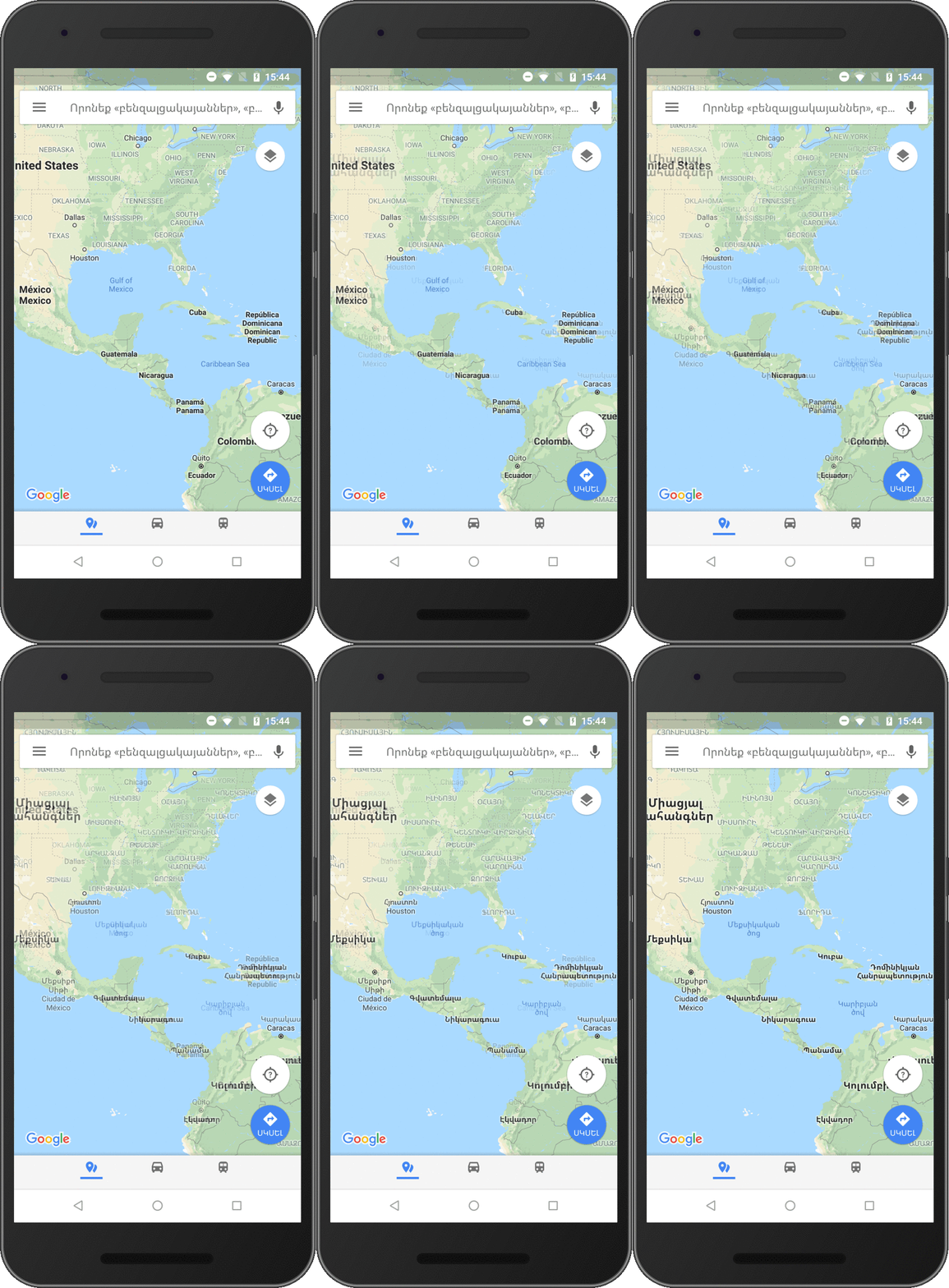
Google has announced that it has added an additional 39 languages to the Google Maps software, enabling an additional estimated 1.25 billion people worldwide to use the app in their native languages. Google also said that over 1 billion people use Google Maps on their computers or mobile phones to get from place to place.

The new languages that were added include Afrikaans, Albanian, Amharic, Armenian, Azerbaijani, Bosnian, Burmese, Croatian, Czech, Danish, Estonian, Filipino, Finnish, Georgian, Hebrew, Icelandic, Indonesian, Kazakh, Khmer, Kyrgyz, Lao, Latvian, Lithuanian, Macedonian, Malay, Mongolian, Norwegian, Persian, Romanian, Serbian, Slovak, Slovenian, Swahili, Swedish, Turkish, Ukrainian, Uzbek, Vietnamese and Zulu.

Google shared the GIF below of Google Maps in Armenian:

The post Google Maps adds 39 new languages supporting over 1B people appeared first on Search Engine Land.

New MarTech Today guide: Integration Platform as a Service (iPaaS)

Enterprise demand for a more effective way to integrate martech applications is fueling the growth of integration platform as a service (iPaaS) solutions. These cloud-based tools act as integration “hubs” that connect software applications deployed in different environments (e.g., cloud vs. SaaS vs. on premise). The specific services offered can include building, testing, deploying and managing software applications and APIs.

Martech Today’s all-new “Integration Platform as a Service (iPaaS): A Marketer’s Guide” examines the market for Integration Platform as a Service tools and what you should expect when implementing this software in your business. This 52-page report is your source for the latest trends, opportunities and challenges facing the market for iPaaS tools as seen by industry leaders, vendors and their customers.

Included in the report are profiles of 16 leading iPaaS vendors, pricing charts, capabilities comparisons and recommended steps for evaluating and purchasing. Visit Digital Marketing Depot to download your copy.

The post New MarTech Today guide: Integration Platform as a Service (iPaaS) appeared first on Search Engine Land.