Thursday, March 1, 2018

SearchCap: Google’s antitrust infringement, Bing Ads ‘fan’ community & technical SEO

Below is what happened in search today, as reported on Search Engine Land and from other places across the web.

From Search Engine Land:

Recent Headlines From Marketing Land, Our Sister Site Dedicated To Internet Marketing:

Search News From Around The Web:

The post SearchCap: Google’s antitrust infringement, Bing Ads ‘fan’ community & technical SEO appeared first on Search Engine Land.

Google’s antitrust infringement continues ‘unabated’, Google Shopping competitors tell European Commission

Comparison shopping engines aren’t satisfied with Google’s response to the European Commission’s demand that the search giant give equal treatment to competitors.

“Google’s current remedy proposal has been in operation for more than four months, and the harm to competition, consumers and innovation caused by the infringement established by the Decision has continued unabated,” a group of Google competitors wrote in an open letter [pdf] to Commissioner for Competition Margrethe Vestager at the European Commission this week.

After the European Commission levied a record nearly $3 billion fine against Google in an antitrust ruling for favoring its own Shopping ads and squeezing out rivals, Google established Google Shopping as a separate business unit to compete in the ad auction against other comparison shopping engines (CSEs).

That change was supposed to take effect last fall, but ads from competitors have been slow to appear and remain scarce. We’ve recently reported on competitor ads beginning to show occasionally in the UK. In the tweet below, Head of SEM at Bloofusion Martin Roettgerding, said they remain rare in Germany and shared an example of links to competing shopping engines appearing at the end of the carousel.

In the letter to Commissioner Vestager, the group cited three reasons why Google’s remedy is non-compliant with the Commission’s decision:

  1. The fact that the new EU Google Shopping unit remains owned by its parent company means its “participation in the auction is essentially meaningless”.
  2. When an auction is fully- or over-subscribed, it “inevitably leads to competing services being charged a fee that has the equivalent object or effect as the infringement established by the Decision”.
  3. Google is still favoring the aggregation of product ads that “in itself constitutes a comparison shopping service” in its search results.

That last point gets to a primary complaint by the rival CSEs that Google Shopping’s switch to an auction-based paid service away from an organic relevance-based system “has terrible consequences for consumers”.

“We respectfully urge the Commission to reject Google’s current remedy proposal and to hold Google to an effective remedy that complies with the principles of equal treatment set out in the Prohibition Decision,” said the 19 signatories, which includes the British comparison site Foundem whose complaints initiated the Commission’s investigation, Twenga and Yroo among others.

Google says it is complying with the decision even as it disputes it and is appealing the ruling.

A spokesman for the European competition authority told Reuters, “The letter raises several arguments that the Commission has already been looking at as part of its ongoing assessment of Google’s measures.”

The post Google’s antitrust infringement continues ‘unabated’, Google Shopping competitors tell European Commission appeared first on Search Engine Land.

You’ll love what the SMX Advanced agenda has to offer

SMX® Advanced is returning to Seattle June 11-13 and I’m thrilled to announce that the agenda is live! Join us for the only conference designed exclusively for experienced search marketers like you.

At Advanced, we hit the ground running and don’t stop. No basics, no holds barred. If two full days of intensive SEO & SEM training are what you’re after, register now to lock in best rates. SMX Advanced sells out EVERY year, so don’t wait.

This year’s agenda features the latest and greatest news and insights covering the areas that matter most to serious professionals, including SEM, SEO, local and mobile search, social media marketing, analytics and conversions, and more. Attend groundbreaking, expert-led sessions including…

  • SEO Ranking Factors In 2018: What’s Important, What’s Not
  • Conversion Optimization: Turning Quick Wins Into Winning Streaks
  • A Deep Dive Under The Hood Of Google’s New Search Console
  • Mobile First & AMP For The Advanced SEO
  • Optimizing For Voice Search & Virtual Assistants
  • Solving Complex SEO Problems When Standard Fixes Don’t Apply
  • Storytelling With Social Ads That Sell
  • Making Your Analytics Work Harder & Smarter
  • Advanced Technical SEO: Page speed, Site Migrations, Crawling
  • Amazon: How to Optimize, Compete & Win On The World’s Biggest Marketplace

…plus three incredible keynote conversations with Google and Bing you won’t want to miss. See the complete agenda for more.

Don’t miss your only opportunity to attend SMX Advanced this year! Register by April 7 and secure Super Early Bird rates – just $1,795 for an All Access Pass. That’s $500 off on-site rates!

See you in Seattle!

Psst… The 4th annual Search Engine Land Awards are coming to Seattle! Submit an entry by April 13th to earn a spot among the finalists and celebrate with the superheroes of the search community at the evening ceremony and after party. Enter now.

The post You’ll love what the SMX Advanced agenda has to offer appeared first on Search Engine Land.

Are you ready for the attribution changes coming to Google AdWords?

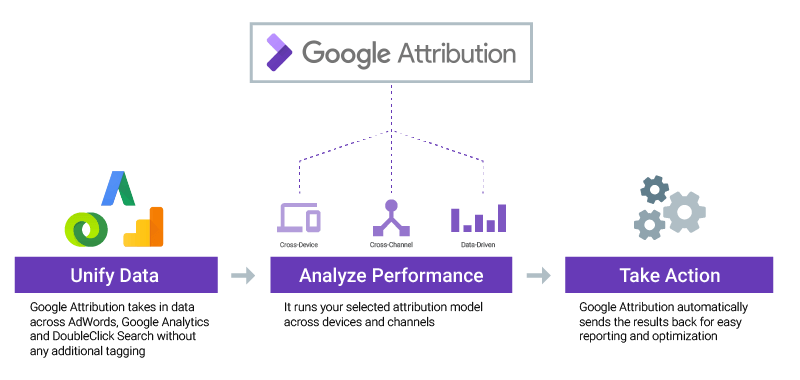
There is an old saying: the only constant in life is change! Word on the street and from Google is they’ll stop supporting last click attribution sometime this year. This means advertisers will have to opt into one of several other attribution models available in Google.

In this article, I’ll provide some general commentary on attribution as well as an overview of the different models available in Google AdWords.

What is an attribution model?

According to Google,

“an attribution model is the rule, or set of rules, that determines how credit for sales and conversions is assigned to touchpoints in conversion paths.”

Currently, the default in Google AdWords is last-click attribution. Last-click attribution gives the click just before the conversion event (like a purchase) 100% of the attribution credit.  Every business has different marketing objectives so tailoring attribution models to those specific goals just make sense.

General pointers on attribution

To get started, here are some general pointers on attribution:

  •  Changing attribution models doesn’t change actual account performance, just your perception of it based on changes to what “counts” as a full or partial conversion. The various models report differently on existing account data so you are free to change models, as long as you inform all stakeholders of the major cosmetic changes and changes that may come with the change.
  • A new attribution model won’t muck up your account. You can go to the attribution models page to view what the various models say about your data, without actually making a change to your default reporting.

Below is a screenshot and you get to the tool by going to conversions > attribution > model comparison tool in Google Analytics.

Rumor has it Google is considering making its darling, the data-driven attribution model, the account default. It will be up to the advertiser to opt into other attribution models. This is similar to how Google automatically opts you into ads that rotate for clicks, users searching in, around, about, etc.

In the sections below, I cover other options for attribution in Google AdWords.

Another option — one I won’t cover fully here — is a function in Google Analytics that gives different weight and credit to different channels like paid search, paid social, email marketing and direct channels. A simple example of this would be to assign 25% to each channel.

It’s interesting that Google’s new attribution technology may now be seamlessly baked into Google Analytics (GA). We have to “adopt” a model, rather than have a separate tool that watches the “watchers”.

Different attribution models

Below is an overview of the five different attribution models that you can choose from in AdWords. They are:

  1.  Linear model. With this, every touch point that contributed to the conversion gets the same score. The first click gets the same amount of credit as the last click. Google seems to apply very partial credit in some cases, as little as 0.1 of a conversion. Does this mean there were potentially ten interactions by that user? Or does Google apply some weighting, even with the linear model? Google’s documentation on this isn’t extensive. This model is useful for any company that wants to sprinkle as much credit as possible around to any keyword that had a role in the user’s consideration process towards a conversion, so they can reduce the number of uninformative “zeroes” in the conversion stats. This can be especially important when we’re dealing with highly relevant, but low volume, long-tail phrases.
  2. Time decay model.  With this, the touchpoints closest in time to the sale or conversion get most of the credit. The keywords consumers interacted with within a few hours of conversion would get the largest weighting. This model is the most similar to last-click and would be considered the most “conservative” change to an existing account. This is an excellent option if you want the same type of attribution that you’re getting currently with a last-click attribution account.
  3. Position-based model. With this, 40% credit is assigned to each the first and last interaction, and the remaining 20% credit is distributed evenly to the middle interactions. I’ve never heard of anyone using this model, but if they did, they’d be looking to move some credit away from the last click, but not give too much credit to repetitive searching in the middle research phase, in cases where consumers really dithered — but would never have done so, perhaps, without the power of that very first interaction. This model is actually very clever.
  4. First-click model. With this, 100% of the credit is given to the first touch point. This is generally used for when companies are looking for growth and focuses on new user/customer acquisition. An example of this would be a company whose goal was to introduce their offering to new prospects so they can remarket to them or place them on an email list and sell them from there.
  5. Data-driven attribution model. Data-driven attribution is the most black box out of all of the attribution models. It analyzes various data points to determine what the specific weighting should be when a conversion occurs. It redistributes credit in favor of converting ads and associated keywords, ad groups, and campaigns.

According to the Google AdWords Blog:

“DDA (data-driven attribution) is different from rules-based attribution models. It uses your account’s conversion data to calculate the actual contribution of each search ad click along the conversion path… The model observes what your customers do before converting, and what they do when they don’t convert, to measure what’s important. Using Google’s machine learning, the models continue to improve over time”.

Note: advertisers have to qualify to use this type of attribution.

Google claims there’s a 5%-10% increase in conversions from data-driven attribution and the company says Ford recently saw a cost-per-click (CPA) decrease of 25% with this model.

I’ve come to expect a CPA increase (of 10% to 20%) from using Google’s automated products, so be prepared.

The post Are you ready for the attribution changes coming to Google AdWords? appeared first on Search Engine Land.

Bing Ads launches ‘fan’ community program for its most dedicated advertisers

Bing Ads is creating a community for its most enthusiastic advertisers to help advance the platform.

Thursday’s announcement from Bing Ads Community Manager Frances Donegan-Ryan says the team is looking for active users who want to engage with the community and help Bing Ads “build better products,” “push us to be innovative” and “advocate for our tools”.

These “Fans” will get benefits such as:

  • the ability to network with other, globally-based search professionals
  • provide feedback on problems and opportunities with the platform directly to the Bing Ads team
  • access to insider news
  • free goodies

Interested users can sign up at the Bing Ads fan page by providing answers to a few questions, some identification information, and their Account ID. It is unclear what the next step or communication in the process is at this time, but the page teases there will be more information soon coming via email and Twitter.

The post Bing Ads launches ‘fan’ community program for its most dedicated advertisers appeared first on Search Engine Land.

Phrase, broad, or broad match modifier: After exact, what’s the next best match type?

Exact Match is widely accepted as the Cadillac of match types in paid search, and for good reason. Queries that exactly match the keyword triggering a paid search ad have the highest conversion rate of any query-to-keyword relationship.  When used, a brand can rest assured the searcher is searching for the exact term targeted.

However, while some brands advertise offerings that can be adequately covered by exact match keywords alone, the vast majority of advertisers rely on broader match types to show ads for rare or new query variations.

In the case of brands with ever-changing, expansive product selections, broader match types are necessary to stay visible for queries which aren’t launched on exact match.

After exact match, which match type performs best?

My analysis of a number of high volume retailers that deploy multiple match types shows there might be little difference between phrase and broad match options for actively-managed accounts.

Little difference in conversion rate for broader match types

Below is a chart depicting Q4 2017 conversion rate relative to pure exact, based on Google’s definition of match type in search query reports. It is assigned based on the relationship of the query to the keyword rather than which match type the keyword triggered is assigned.

As with all match type analyses, these numbers are impacted by variables like keyword coverage, the degree to which paid search managers curate negative keyword lists to block out irrelevant traffic and shepherd queries to closer matches.
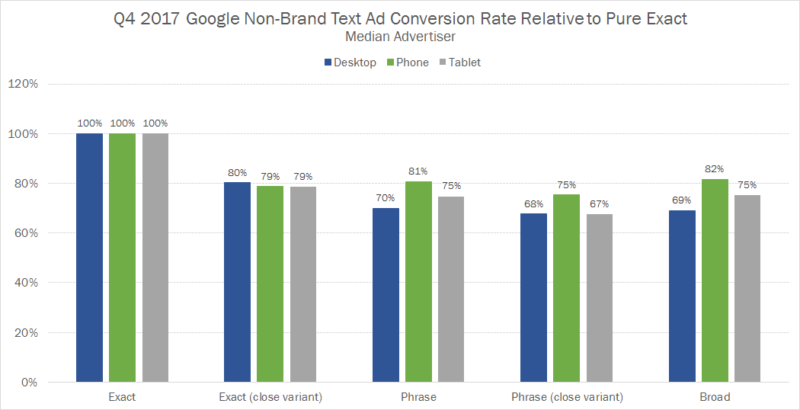
As you can see, pure exact matches had the highest conversion rate of any query-to-keyword match by far.

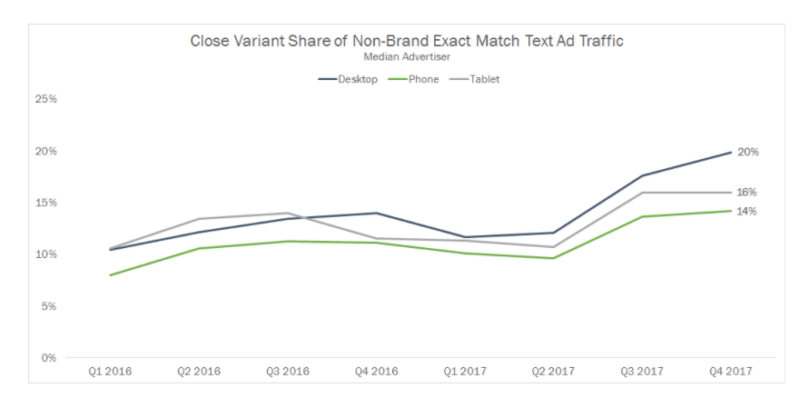
Exact (close variant) outpaced phrase and broad matches on desktop and tablet but was actually slightly lower on phones. The study below from Merkle (my employer) shows exact match close variant traffic share rose in the back half of 2017, this after Google’s change to the definition of what constitutes a close variant.
Comparing pure phrase match to pure broad match, the conversion rate is incredibly close, with no more than a one percentage point difference for any device type.

This is pretty surprising given the phrase match should result in tighter matches than full-on broad match and the general flack broad match has caught in the paid search industry over the years.

It also indicates that there might not be a clear difference in conversion rate between broad match modified (BMM) traffic (which is not reported on in the match type column) and pure broad, since BMM is essentially a looser version of phrase match in which the words must be present but can be rearranged.

These figures are impacted by how well brands deploy negatives to block out poorly-matched traffic, and also vary from keyword to keyword since different terms carry different possibilities for phrase and broad matches.

The answer for whether it’s better to use phrase, broad, or BMM for non-exact keywords might be different depending on your management and account specifics.  It may also depend on which keyword you’re looking for.

Looking at the median advertiser, there’s not a clear answer that can be applied broadly to every type of brand.  Even where differences in value exist, marketers should be able to account for them with proper management.

Bid right

There is an old expression in the paid search industry, “there are no bad keywords, only bad management”.

Even if the value a keyword is expected to drive for an advertiser is very low, the advertiser should set the appropriate bid based on that expectation. If a bid is too low for a keyword to show an ad in the search results, then the keyword won’t get any traffic.

If it’s high enough to get ad impressions, then the bid should ensure that the advertiser spends only what it can afford to when the ad does get clicks.

In the case of keywords with different match types, brands should try to get as much pure exact traffic to keywords set to exact match as possible and set the most precise bids possible for this traffic.

That doesn’t mean brands should forego broader match types. Broad and phrase match keywords can help pull in new or rare variations of a search query and can operate at the same return on ad spend as exact so long as bids are set appropriately.

Keep the negatives tight

Negative keywords are certainly an important part of this, as brands should be looking to block out as much irrelevant traffic as possible so that they may set appropriate bids for a relevant phrase and broad matches.

This is also true of keywords set to exact match, with the evolving definition of close variants steadily expanding the amount of traffic coming from queries that aren’t true exact matches.

Negatives are also important for funneling traffic to the best keyword matches possible to ensure the bids set for those keywords are based on the best possible collection of traffic.

For example, blocking broader match types from being triggered for keywords which exist on exact match within the account. This can be tricky, as Google sometimes clearly prefers odd keyword variations for some queries rather than exact match keywords that perfectly match the query.

Just because pure exact matches convert at a higher rate than other query-to-keyword relationships doesn’t mean brands should only ever rely on exact match.

Even if phrase matches did convert at a meaningfully higher rate than broad matches, it wouldn’t mean brands should only deploy phrase and exact match and ignore broad match. It just means that bids need to be set appropriately for each match type variation.

While my title did specifically frame the question of match types in terms of which was best, it’s really difficult to write a succinct title to describe a post that compares match type conversion rates and argues there is little difference in conversion rates.

It also doesn’t matter; we shouldn’t be pitting match types against each other.

Conclusion

A lot of paid search marketers have very strong opinions on the best match type strategy and many of those opinions have been formed by real-life examples of broad match pulling in terribly unqualified traffic.

This is something pretty much everyone involved in paid search for any length of time encounters to one degree or another. You have to wonder if broad match gives Google too much flexibility to determine relevant queries.

If we really look at how well Google matches the intent of the query when using broad match as judged by conversion rate, it’s not obvious that broad matches will perform worse than phrase matches.

Given that BMM is essentially a more flexible iteration of phrase match, it also follows there probably isn’t a huge distinction between broad and BMM.

As mentioned earlier, specific keywords might benefit more or less from a specific match type than others. However, the data presented here indicate overarching arguments lifting up one (non-exact) match type over others might not be accurate for all advertisers.

Outside of exact matches converting at a meaningfully higher rate than all other match types, the winner seems far murkier than many believe it to be.

The battle shouldn’t be used to eliminate specific match types from paid search campaigns. Any match type can “work,” so long as it’s properly managed.

The post Phrase, broad, or broad match modifier: After exact, what’s the next best match type? appeared first on Search Engine Land.

Keeping up with technical SEO

Remember the phrase “peak oil” that was bandied about by doomsayers just a few short years ago? The notion that the world was about to imminently run out of oil, and that would be the end of cars, planes and trains and everything else that runs on petroleum? “Peak oil” today sounds about as ludicrous as a similarly misguided prognostication made around the same time: namely, the impending “death of SEO.”

Not dead yet! All professional SEOs know that the opposite is true. SEO keeps getting more complex, more sophisticated, more advanced – and ultimately, harder and harder to keep up with.

If you’re trying to keep up to speed with the contemporary SEO landscape, or if you’re looking to broaden your skills with more nuanced tactics and techniques, you should attend the Hardcore Technical SEO Tactics & Techniques workshop at SMX West.

Taught by well-known and respected SEO expert Eric Enge, the full-day workshop is a deep dive into the best of the best techniques and methods that help you drive your SEO efforts to success.

Want to know more what to expect from the workshop? Click over to Five questions for 2016 Search Personality of the Year Eric Enge. Eric maps out the topics and tactics he’ll be discussing, describing the technical aspects he’ll be covering and also showing how what you’ll learn can provide solutions to business issues as well.

The post Keeping up with technical SEO appeared first on Search Engine Land.