Monday, February 1, 2016

Google Search iOS App Adds “I’m Feeling Curious” To 3D Touch

google-apple-green3-1920

Google added a small but cute feature to the Google iOS search app that lets users hard press on the app and brings up a “3D touch menu” for the “I’m Feeling Curious” button.

This is to make it faster for searchers to get “a fun fact” from Google.

But more importantly, it is to represent the “I’m Feeling Lucky” button variations directly in their very popular search app.

Here is a picture:

google-ios-3d-im-feeling-lucky

Again, you can activate that menu on your iPhone 6S by hard pressing on the app icon.

The post Google Search iOS App Adds “I’m Feeling Curious” To 3D Touch appeared first on Search Engine Land.

Valentine’s Day Searches Start Now: When They’ll Peak Depends On The Category

bing-ads-grad-fade-1920

February 1 is here, and that means Valentine’s Day searches are set to begin surging right up to February 14.

New data from Bing provides key trends on Valentine’s Day-related searches — including gifts, candy, flowers, restaurants and jewelry — and ad performance to help guide marketers’ efforts in winning over consumers in this year.

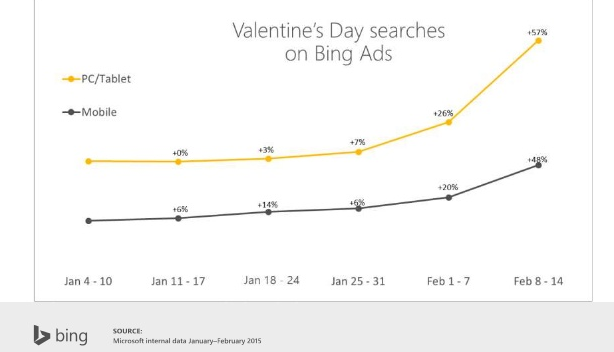
This week will see more activity than last week, but the real surge in searches happens in the final week before Valentine’s Day. Looking at last year’s search history from Bing, the final-week spike was more dramatic on desktop than on mobile in 2015, On desktop, searches in the final week (February 8–14) increased 77 percent, while mobile searches rose by 71 percent from the prior week.

valentines day search trends bing ads

Overall, mobile accounted for 32 percent of Valentine’s Day-related searches and 17 percent of clicks on Bing last year.

The Bing data show that Valentine’s Day Gift-related searches peaked on February 11 last year, while candy and chocolate searches didn’t top out until February 13.

Surprisingly, jewelry searches skyrocketed from February 12 right through to February 14. These differences point to the need for customized budget and bidding strategies depending on the types of terms and products advertisers are competing for in paid search.

valentines day searches by category

Overall, click-through rates were highest between Februrary 10 and 14, averaging 4.9 percent. On desktop, click-through rates peaked in the afternoon of Feburary 12 between 2:00 and 8:00 p.m. On mobile, last minute-shoppers and reservation-makers drove CTRs highest on Valentine’s Day between 3:00 and 10:00 p.m.

For more Valentine’s Day data, including ad copy and keyword insights, see the full presentation from Bing on SlideShare, available here.

The post Valentine’s Day Searches Start Now: When They’ll Peak Depends On The Category appeared first on Search Engine Land.

Google Expanding Candidate Cards, Will Also Offer Primary Voting Reminders

democrat-republican-politics-ss-1920

Building off an experiment following the most recent Republican debate, Google will begin providing more in-depth election-related content in search results about the candidates and key issues. In search and Google Now, users will be able to get a combination of candidate-generated content and third party content about the primaries and the election.

These are not “candidate listing ads.” Google previously said there’s no advertising angle.

While the information is clearly useful, Danny Sullivan criticized last week’s launch of candidate cards as a “disaster for search quality.” However, searches for specific issues or individual candidates may be less vulnerable to the sorts of problems he identifies in connection with the Republican debate (i.e., dominance by a single candidate).

Placement in search will be variable, depending on the query. Often, however, cards will appear at the top of results. As previously discussed, candidates will be able to provide their own statements and content. But Google will also be aggregating articles and providing “scorecards” for candidates based on state primary outcomes and delegate counts.

Google explains in a blog post:

Tracking what’s happening in the primaries and how each candidate is doing state-by-state can be hard. So now when you search for “primary results” or “resultados de la elección primaria” you’ll not only see the primary election schedule, but you’ll also see live results and an evolving tally of how many delegates each Republican and Democratic nominee has received. This feature works in English and Spanish.

Perhaps the most interesting thing Google will be doing is reminding people to vote. Cards will inform voters of the dates of their their state primaries. Google will also direct users to their polling places.

google now voting reminder

It will probably be difficult to measure the effect of voting reminders on turnout but it could have an impact, which would not only be interesting and socially beneficial but could potentially influence primary outcomes at the margins — especially with younger, more mobile-centric populations.

Another interesting and less obvious aspect of candidate and issue cards is that they might operate as an instant fact-checking vehicle for voters and journalists. This was something discussed ten years ago by Google Executive Chairman Eric Schmidt as one of the social and democratic benefits of search.

The post Google Expanding Candidate Cards, Will Also Offer Primary Voting Reminders appeared first on Search Engine Land.

10 Local Link Building Tips for 2016

12 local linkbuilding tips for SMBx

The conference season has kicked in already, and I’ve been overwhelmed with how many businesses have been asking for more local link building tips. I wrote a post here last spring about local links, but it was more focused on sharing the importance of local links. This time, I’m here with actual down and dirty tips.

As I mentioned before, traditional link builders only target links from sites with high Domain Authority (DA). They’re cautious of Penguin, and they want as much link juice as possible. With Local SEO, I often find that we’re taking the opposite approach.

Many times, I prefer a link from a site with low DA, as long as it’s a local website. Heck, we even actively target nofollow links (That sigh you just heard was all the traditional link builders freaking out). Even with low authority and nofollow, a link from a local site carries a ton of local relevancy.

Don’t forget: When you’re building links, it’s not only about the inbound link for SEO value. If you get quality links on local sites, they’re links that humans will actually click on. Those local links will bring you more traffic, and they’ll increase your brand’s visibility.

So without further ado, let’s jump into a few local link building tips that will work for any business vertical:

1. Alumni Or Military Discounts

Offer a discount to alumni from a few local universities. Once you’ve got a page on your site explaining the discount, it’s usually quick and easy to reach out to local alumni groups and get added to their sites. Military discounts work well, too, but these typically require a bit more outreach and follow-up to get links.

2. Local Meetups

Local meetups are an untapped gold mine for local links. Head over to Meetup.com and check out the active groups in your area. Look for groups that are related to your business first, then branch out to other local groups. First, you’ll want to go after groups that are looking for a location for their meetings. Offer up your place of business, and BOOM! You’ve got an easy local link.

If you can’t find anyone looking for a place to meet, look for groups that are seeking sponsors. For $50–$100 a month, you could sponsor the refreshments at one of the meetups, and BOOM! You’ve got another easy local link.

3. Host A Community Event

Throw a party and invite the entire city — it’s that easy! Check out what your local auto dealers do on holidays (They’re always throwing great local events).

Whether it’s a 4th of July cookout or an Easter egg hunt for the kiddos, if you host an event that’s open to the community, it’s really easy to get links (and social mentions).

4. Create A Local Resource Page

Whenever I talk about local resource pages, people think I’m talking about trading links with local businesses. That’s not what we’re doing here. With a local resource page, you’re sharing information with outsiders about something in the area that you’re passionate about.

If you’re a connoisseur of smoked meats, share a list of the best barbecue joints in your city. If you love to spend time outdoors with your kids, publish a list of the best activities in town for children. If it’s useful information about your area, other sites will link to you.

5. Local Awards

Nearly every city has some sort of local business awards. They might be vertical-specific, or crowd favorites, or they might even be related to community service.

Do some research and find out what local awards your business might be eligible for, and get yourself nominated. The results are nearly always published online, which means the winners typically get links.

6. Take Advantage Of Relationships You’ve Built

Unless you’ve just opened, your business has been a part of the local community for a while. You’ve built relationships with other local businesses, so take advantage of those relationships and mine them for links.

Think about other businesses that are similar to yours or that support your own — or even businesses in unrelated verticals whose owners you’re simply friends with. Since you already know the owners, it’s typically incredibly easy to get those links.

7. Local Figures

An interview with a local figure is another easy way to get some great local links. Think about the relationships you already have. Do you play golf with someone on the city council? Do you go to church with the mayor?

If you’re not directly connected with a local figure, maybe one of your close friends knows someone — or maybe a local figure is a regular customer. Network a bit, and set up an interview with the person. Once it’s published, you’ll be primed to get some juicy local links.

8. Local Directories

You should be hitting your local directories for citations anyway, but they’re also a great source for local links.

Most every city has its own small directories, so do a quick Google search, find them, and get your business listed.

9. Local Blogs

Find local bloggers and start to network — once you’ve built a relationship with them, it won’t be hard to get them to write about your business and include a link.

10. Sponsor A Little League Team

This one’s our go-to pro tip for local link building. For a few hundred bucks, you can sponsor a local Little League team (or any sport, for that matter).

It’s a feel-good warm and fuzzy that makes your business look great to the community, but it also gets you a really great link from a hyper-local website.

Now, go forth and build some awesome local links!

The post 10 Local Link Building Tips for 2016 appeared first on Search Engine Land.

Frederick Douglass Google Doodle Opens Black History Month Celebrating Revered U.S. Abolitionist

frederick-douglass google logo

As we begin Black History Month, Google is celebrating the revered American abolitionist, orator and author Frederick Douglass with a doodle created by guest artist Richie Pope.

Pope’s image was inspired by Douglass’s work as the publisher of “The North Star” newspaper. Limited to only Google’s U.S. homepage, the logo links to a search for “Frederick Douglass.”

Beneath the Frederick Douglass logo, Google has included a link to “Explore the life and work of Frederick Douglass” which leads to the Google Cultural Institute Black History and Culture website.

For a biographical sketch of Douglass, Google turned to Sandra Trenholm, curator and director of the Gilder Lehman Institute. According Trenholm, Douglass learned at age eight education was a direct path to freedom after being taught the alphabet by his owner Sophia Auld.

“The frequent hearing of my mistress reading the Bible aloud…awakened my curiosity in respect to this mystery of reading, and roused in me a desire to learn,” writes Douglass in his autobiography.

Born Frederick Bailey, Douglass changed his name to Frederick Douglass in 1838 when he escaped slavery. By 1845, he had published his first autobiography “The Narrative of the Life of Frederick Douglass: an American Slave.” Through his anti-slavery speeches and writings, he rose to become one of America’s most famous abolitionists.

During his lifetime, Douglass published three autobiographies, founded five newspapers and served as the U.S. Consul to General to Haiti.

Google shared the following early sketches of Pope’s doodle, featuring Douglass with one of his newspapers as a backdrop, and among his many books:
Frederick douglass sketch

Even as one of the most esteemed and important American historical figures, Trenholm says Douglass spent his life not knowing the date or year of his birthday.

“The principal thing I desired in making the inquiries I have of you was to get some idea of my exact age,” wrote Douglass to the son of one of his former owners in 1877, “I have always been troubled by the thought of having no birth day.”

Douglass died a year after sending that letter, not knowing when he was born. Later, historians would learn from a plantation slave record that Douglass’s birth occurred in 1818, but an exact date was left unknown.

To celebrate Douglass, Google is offering a free download of “Narrative of the Life of Frederick Douglass: an American Slave” via Google Play today through its partnership with Open Road Integrated Media.

The post Frederick Douglass Google Doodle Opens Black History Month Celebrating Revered U.S. Abolitionist appeared first on Search Engine Land.

7 Ways Small Businesses Can Leverage Third-Party Apps for Local Search & Marketing

Much of the growth in mobile can be attributed to apps. In its 2015 US Mobile App Report, comScore reports that while time spent in mobile digital media use has grown 49 percent since 2013, app usage grew by 90 percent during that same period and constituted 77 percent of all time spent on digital media.

With all that time spent on apps, is there a way that local businesses can get a piece of the action?

The problem is that the average smartphone user only visits about 25 apps each month — and 96 percent of time spent on smartphone apps occurs in the user’s top 10 apps. (Tablet users are even higher, spending 99 percent of their app time on their top 10 apps.) That doesn’t leave much room for a small local business to get attention via its own app.

The one exception might be for businesses built on frequent habitual use, like coffee shops or fitness centers. Popular apps like Facebook get regular return visits through constantly updated news feed content that users get into the habit of checking. Starbucks increased unique users of its app by 100 percent from 2013 to 2015, comScore finds, and Dunkin Donuts, while capturing fewer visitors overall, increased use by 456 percent in the same period. Never underestimate the power of users’ strong daily coffee habits.

Nevertheless, building a solo app likely isn’t a good investment for your average local business. But there are ways that local businesses can get exposure on third-party apps. ComScore ranked the Top 25 apps by unique visitors, as illustrated in the chart below.

ComScore Top 25 Mobile Apps By Unique Visitors

Source: The 2015 U.S. Mobile App Report, comScore

While a vast national user base for these third-party apps may not seem relevant to a local business that is only trying to attract a tiny segment of the market, broad use means there is a greater chance that the local business’s audience uses the app and therefore can help provide exposure for the store or business.

Below, I look at seven ways small businesses can take advantage of third-party apps to help drive search results and customers to their stores.

1. Same Bat Time, Same Bat Channel For Google

While Google Search isn’t the #1 app used as measured by unique visitors, it remains the dominant app used to search for information (and is still ranked at #4 overall). Just as importantly for local search, Google Maps ranks at #6, and Google+ is in comScore’s top 20. YouTube, also owned by Google, is the second-most used app and does play a function in search.

There appears to be no difference in search results between mobile search on Google’s mobile site and Google’s search app, although some of the 3-pack local search results that appear at the top do vary. This simply emphasizes the importance of making sure you claim your business on Google My Business and that you keep your business profile up-to-date. That includes business name, location, contact details, description, photos and business hours.

It might seem basic, but maintaining an accurate and up-to-date profile is just too important not to emphasize, and the impact is cross-media and cross-platform on Google, including on search, maps, Google+, desktop, mobile web and mobile apps.

Also, Apple Maps is ranked #11. Don’t forget to claim your business on this platform, which will also impact voice search through Siri.

2. Facebook: The Goliath App

That Facebook is the #1 app by unique visitors is no surprise. But its margin of dominance might be.

Per comScore, the Facebook app is installed on more than 70 percent of all smartphone users’ mobile devices. It hogs time spent on apps, with almost 50 percent of its users spending more time on Facebook than any other app — and it is in the top three apps (in terms of time spent) for 80 percent of its users. In the app equivalent of page one rank, Facebook is on more than 45 percent of users’ home screens, with Google Search (the closest competitor) appearing on less than 30 percent of home screens.

This makes Facebook a great tool for engaging with existing customers who are likely familiar with and active on the app. Small businesses can post photos of new products, communicate special offers or discounts, educate with timely tips or talk about upcoming events, all of which appear as posts on customer news feeds (subject to Facebook’s news feed algorithm).

“Boosted” posts are paid for like ads and appear higher up in user news feeds, increasing the chances that they will be seen.

Using Facebook pages allows local businesses to take advantage of the time users spend on the app while encouraging engagement with the business and keeping the store or service top-of-mind for customers.

3. Messaging: Virtually Exclusive On Apps

Facebook also has a massive presence in another category of app: messaging. Almost all messaging now occurs through an app — comScore reports that 91 percent of instant messaging is driven by apps. Facebook Messenger ranks #3 in unique users, while Snapchat ranks #17.

With the proliferation of texting and the comfort users have with messaging, consumers will start expecting to likewise communicate with businesses this way. Facebook has started facilitating this communication via “click to message” ads on Messenger. A user who clicks on the “message” button on the ad will be prompted to type a question or comment, and the business pays for the ad once it is sent.

Facebook Messenger Advertising

Source: Facebook

Facebook will also begin allowing businesses to private message replies to comments posted on the business’s Facebook page. Together, these functions allow businesses to further engage personally with customers and respond quickly to questions, both of which improve customer experience with the business.

Snapchat’s advertising is based in the platform’s curated content via Discover and Live, both of which still focus on the use of video or photo “snaps.” Discover contains content from popular publishers such as Mashable, BuzzFeed, People and ESPN. Live consists of user snaps from a common location or event. Advertisers can target based on content and location but should be aware of the platform’s heavy Millennial user base.

Nevertheless, Snapchat remains an intriguing platform for advertising, given its emphasis on video. ComScore reports double-digit lift in five of six measurements of the effectiveness of native mobile video: mobile ad recall, ad uniqueness, favorability, likelihood to recall and purchase intent.

ComScore: Brand Lift of Video

Source: The 2015 U.S. Mobile App Report, comScore

4. Not Your Father’s Directory

Directory listings may have evolved in the way they are presented, but they are still one of the primary ways that consumers find information on local businesses. Every major directory listing company has an app, and many are using additional functionality to attract users.

From YP’s app, you can directly book a table, order online, buy movie tickets and find cheap gas. Yellowbook highlights weather and emphasizes location through maps and its Google-esque “Nearby” search feature.

YP and Yellowbook Mobile Apps

Vertical-specific directory listings have also had great success with apps. OpenTable leveraged online reservations to build its directory. GrubHub specializes in ordering takeout or delivery. And Yelp, best known for its directory of food and drink establishments, made online reviews ubiquitous with listings.

Consumer local search behavior shifted to mobile sooner than general internet use, in large part because consumers began to seek information on local businesses while on the go. Certain content categories are now driven primarily by app use for that same reason: on-the-go utilities such as Maps, at 89 percent, and Weather, at 78 percent, get most of their digital time spent from apps.

Directories are likely to follow suit, especially those in local search verticals such as restaurants, as they adapt to on-the-go usage behavior by incorporating directions, click-to-call links and e-commerce functionality. In order to take advantage, local businesses need to make sure their links and listings accommodate functions like on-the-go orders or reservations and that their location on maps is accurate.

5. Food & Retail Are Perfect For Visual Discovery Apps

Social media is the single largest app category in time spent on apps, at 29 percent of all time spent. While social media is very effective for engaging with existing customers, I’ve generally been of the opinion that it is less effective in helping customers search for and discover new local businesses.

The exceptions are restaurants and retailers, who can use visuals to highlight their products. Instagram is in the Top 10 and Pinterest in the Top 15 of comScore’s app rankings by unique visitors, and both use images as their primary mode of sharing. Users love to browse through pictures, and it’s a great opportunity for businesses to be creative and use color, art, photography, video and shot selection to showcase stores and products.

Pinterest and Instagram Mobile Apps

Pinterest recently recognized the value it brings to food and retail businesses by announcing that it was only providing full customer support for businesses in those sectors.

And Instagram lifted its restriction on advertising to select brands a few months ago so that all businesses can take advantage of finely tuned targeting using data from its parent company, Facebook. Advertisers are given more content options than free users, such as longer videos (30 seconds) and permission to link to outside platforms or pages through calls to action.

6. Apps Will Open Doors To Other Marketing Technologies

Beacon technology seems to offer incredible potential for business. It provides real-time notice of who’s walking into a store (or even a specific part of a store) and helps to serve up personalized offers or information at the right time and right place.

However, beacon use for local businesses suffers a derivative problem related to apps. Beacons usually interact with a store’s app to identify patrons, a problem if the store doesn’t have its own app.

Solutions are developing, though. The same third-party apps that local businesses can leverage now will eventually expand their functionality to beacon technology. It’s already happened with Facebook. Last year, the company started giving away beacons that would trigger “Place Tips” when a customer accesses Facebook while in the store, assuming Bluetooth and location sharing are on.

“Place Tips” works like a dedicated page that curates a mix of friends’ posts and pics that mention the business and content from the business’ own page to provide helpful information to the user. It also encourages engagement through likes and shares.

facebook for beacons

Source: Facebook

While businesses currently have limited control over pushing specific content to users triggered by the beacon, it’s easy to see how a popular app like Facebook will continue to grow these opportunities and open doors for small businesses to benefit from this and other new technologies.

7. App Content Indexed For Search

Coming full circle back to Google Search, the search engine is now including app-only content in its search results. Google will even stream certain apps (in other words, functions normally performed within an app can now be completed on the web).

This has a number of implications:

  • SEO must now account for app content competing with websites and the effect that has on PageRank.
  • App developers must optimize app content for search algorithms.
  • Small businesses that couldn’t rely on enough volume to justify developing an app may get sufficient search exposure to their apps to change that investment decision.
  • App content on pages of popular websites such as Facebook will become even more important.

Conclusion

Mobile web still remains the primary platform local businesses need to adapt to. When comparing the Top 1000 mobile apps to the Top 1000 mobile web properties, the web still has 2.5X the audience of apps, and the latter is growing twice as fast.

Nevertheless, app users are loyal, and their use consumes most of the time spent on mobile devices — a sufficient reason to warrant an app marketing strategy, even for small businesses.

In the current marketplace, most local businesses won’t want to invest in an individual app, but there are still many ways that they can leverage space on the most popularly used apps to gain exposure to both existing and new customers.

And it’s important to keep an eye out on developments in the space, as technology continues to boost the utility of having a presence on third-party apps and may change the ROI calculation for local businesses to develop their own.

The post 7 Ways Small Businesses Can Leverage Third-Party Apps for Local Search & Marketing appeared first on Search Engine Land.

Google’s Fake Locksmith Problem Once Again Hits The New York Times

google-small-local-my-business-hospital-ss-1920

Almost five years since the New York Times profiled the issue with Google’s local results and locksmiths, the New York Times published a fresh story around the issue this weekend.

The story is named Fake Online Locksmiths May Be Out to Pick Your Pocket, Too. It goes through how local locksmiths are locked out of the local results because of all the fake, call-center based locksmiths that are hacked into the Google local results.

When a searcher begins looking for a local locksmith, instead their phone calls often goes to a call center, which then may send “poorly trained subcontractors” to charge you a lot more money than you were quoted on the phone. The subcontractor arrives on the scene and then often will require the person locked out of their car or house to pay three or four times what was quoted on the phone.

The goal of lead gens is to wrest as much money as possible from every customer, according to lawsuits. The typical approach is for a phone representative to offer an estimate in the range of $35 to $90. On site, the subcontractor demands three or four times that sum, often claiming that the work was more complicated than expected. Most consumers simply blanch and pay up, in part because they are eager to get into their homes or cars.

Where are these locksmiths from? The New York Times uncovered companies, often not based in the local area, that set up fake locations within Google Maps to trick the algorithm into thinking they are a local based company. These companies can literally be found in all metro areas but all phone calls typically go to a single call center, not located in the metro-region.

A Google spokesman told the New York Times that the company worked hard to check bad actors and quickly removed listings that violate its policies.

The truth is, not much has changed in terms of this issue in the local results at Google in the past five years. It is almost impossible for Google to manually remove all these fake listings and as they do remove them, several more pop up every day. The algorithm simply doesn’t work in this case.

Check out the very detailed article on the problem, who is causing it and how Google is unable to prevent it at the New York Times.

The post Google’s Fake Locksmith Problem Once Again Hits The New York Times appeared first on Search Engine Land.